


What if the persistent ache in your lower back or the numbness in your hands wasn’t a mandatory price of admission for being a cyclist? Many riders mistakenly believe that physical suffering is a rite of passage, especially when they begin to feel “stretched out” or cramped after thirty miles on a new frame. You’ve likely spent hours adjusting your saddle height by feel, only to find that the same nagging knee pain returns every weekend.
Recognising the signs you need a bike fit is the first step toward aligning your equipment with your unique anatomy. In this clinical guide, we’ll help you discover the technical signals your body is sending and explain how professional biomechanical analysis transforms chronic discomfort into sustainable performance. We will examine why common issues like genital numbness or hand tingling are often symptoms of correctable geometry errors rather than personal physical failings. By the end of this article, you’ll understand how to eliminate pain whilst increasing your power output and aerodynamic efficiency through data-driven optimisation and informed decision-making.
Key Takeaways
- Learn to distinguish between productive muscular fatigue and the mechanical pain that indicates a fundamental setup error.
- Identify the physical signs you need a bike fit, ranging from persistent knee discomfort to the chronic lower back strain caused by improper reach.
- Discover how to resolve numbness in the hands and sensitive areas by addressing ulnar nerve compression and saddle pressure distribution.
- Understand how professional biomechanical analysis can eliminate “mechanical leaks” to reclaim wasted energy and improve your power output.
- Explore the “fit-first” philosophy and why technical sizing is a critical step before purchasing a new frame to ensure long-term anatomical harmony.
Is Discomfort a Rite of Passage? Why We Normalise Cycling Pain
In the cycling community, there’s a pervasive culture of endurance that often borders on the masochistic. We celebrate the “hard man” or “hard woman” who pushes through the elements, yet this mindset frequently leads to the normalisation of deviance. In biomechanical terms, this occurs when a rider accepts persistent physical distress as a standard part of the sport rather than a signal of mechanical misalignment. It’s vital to recognise that whilst cycling requires effort, it shouldn’t require suffering.
A professional bike fit isn’t merely a tool for elite racers chasing marginal gains; it’s a fundamental investment in your physical longevity. Every rider’s biomechanical profile is an individualised journey. What works for a professional in the peloton won’t necessarily suit a weekend enthusiast with different flexibility markers and injury histories. Moving beyond “making do” requires a shift in perspective, viewing your bicycle as a technical extension of your body that must be calibrated with clinical precision.
The Threshold Between Fatigue and Injury
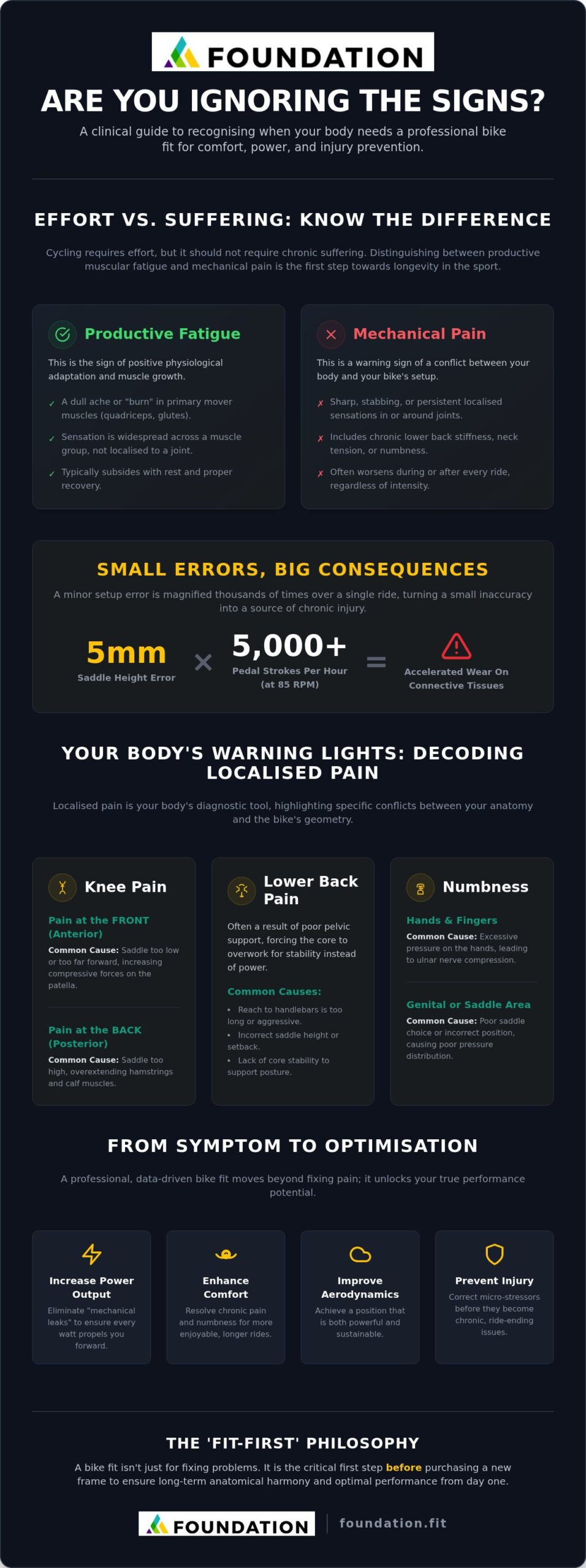
Distinguishing between productive muscular fatigue and mechanical pain is a critical skill for any cyclist. You should expect a dull ache or “burn” in the primary movers, like the quadriceps or glutes, during a strenuous climb. This is physiological adaptation. However, sharp, localised sensations in the joints, or persistent signs you need a bike fit such as lower back stiffness, indicate a conflict between your anatomy and the machine.
Consider the sheer volume of movement involved. At an average cadence of 85 revolutions per minute, your legs complete over 5,000 cycles in a single hour. If your saddle height is off by just five millimetres, that minor error is magnified 5,000 times every hour. Toughening up won’t fix a sub-optimal pivot point; it only accelerates the wear on your connective tissues. Professional intervention identifies these micro-stressors before they manifest as chronic inflammatory conditions.
When “Making Do” Becomes a Risk
Many riders attempt to self-correct using generic height charts or online calculators. Whilst these provide a baseline, they are a poor proxy for true bike sizing because they ignore variables like foot arch height, pelvic tilt, and functional reach. When you try to adjust your setup without a baseline biomechanical assessment, your body doesn’t just stop; it compensates. This is one of the most common signs you need a bike fit.
If your reach is too long, you might over-recruit the trapezius muscles to stabilise your torso, leading to chronic neck tension. These compensations are often the earliest indicators of trouble. By the time the pain becomes unbearable, your nervous system has already “baked in” these inefficient movement patterns. Precision data allows you to move from reactive “fixing” to proactive optimisation, ensuring your muscles work in harmony rather than in opposition to your frame.
The Biomechanics of Localised Pain: Knee, Back, and Neck Signals
Localised pain is rarely a random occurrence. Instead, it serves as a biomechanical diagnostic tool, highlighting specific areas where your body’s geometry and the bike’s dimensions are in conflict. When you experience recurring joint or muscle strain, these are primary signs you need a bike fit to recalibrate your contact points and ensure your anatomy is properly supported.
Decoding Knee Pain: Anterior vs Posterior
Knee discomfort is often the most immediate signal of an incorrect setup. Pain at the front of the knee (anterior) typically suggests a saddle that is too low or positioned too far forward, which increases the compressive forces on the patella during the power phase of the stroke. Conversely, pain at the back of the knee (posterior) is often caused by a saddle that is too high, forcing the hamstrings and calf muscles to overextend to reach the bottom of the pedal revolution. Patellofemoral syndrome in cycling is often the result of repetitive, sub-optimal tracking of the kneecap caused by incorrect cleat or saddle positioning. This highlights why a Full Bike Fit is essential to ensure the knee tracks safely through every revolution.
Lower Back and Pelvic Stability
The lower back often compensates for poor pelvic support. If your saddle setback is incorrect or the reach to the bars is too aggressive, your pelvis may tilt forward excessively, placing the lumbar spine under constant tension. This lack of mechanical support forces your core to work overtime just to keep you upright, rather than focusing on power delivery. One of the most visible indicators of this imbalance is “rocking hips,” where the pelvis shifts side-to-side because the saddle is too high for the rider to maintain a stable platform. This instability prevents effective glute engagement and leads to premature fatigue. The biomechanics of the lower body function as a kinetic chain; a seemingly minor misalignment in cleat position at the foot can travel upwards, manifesting as a persistent hip issue.
Neck and Shoulder Tension
Upper body discomfort is frequently linked to “Reach” and “Stack” measurements. When the distance between the saddle and handlebars is too long, the rider is forced to crane their neck upward to see the road, which can lead to the extreme fatigue known as Shermer’s Neck. Similarly, if your handlebars are too wide, your shoulder blades are pulled into an unnatural position, causing tension across the upper back. Proper stack height ensures a balanced weight distribution, preventing you from leaning too heavily on your hands and shoulders. This allows for a more relaxed, sustainable posture that doesn’t compromise your ability to handle the bike safely.
Addressing Numbness and Pressure: When Contact Points Fail
Whilst joint pain often signals a mechanical misalignment, numbness is a neurological warning. It indicates that a nerve is being compressed or that blood flow is being restricted by excessive pressure. These sensations are amongst the most unmistakable signs you need a bike fit, as they suggest that your body’s three primary contact points-the handlebars, the saddle, and the pedals-are not effectively distributing your weight.
Hand Numbness and “Cyclist’s Palsy”
Numbness in the hands, often referred to as “Cyclist’s Palsy,” typically involves the ulnar or median nerves. When your centre of gravity is too far forward, you end up “propping” yourself up on the bars rather than using your core for stability. This places immense pressure on the palms. If the numbness is concentrated in the pinky and ring fingers, the ulnar nerve is the likely victim. If it affects the thumb and index finger, the median nerve is being compressed.
Correcting this requires more than just thicker bar tape. We must analyse variables such as:
- Handlebar Tilt: Ensuring a neutral wrist position to prevent “kinking” the nerves.
- Hood Position: Moving the brake hoods to provide a flatter, more supportive platform.
- Reach and Drop: Adjusting the cockpit so you aren’t overreaching, which naturally shifts weight off the hands.
The Science of Saddle Comfort
A common misconception is that a wider, softer saddle is the solution to pelvic discomfort. In reality, excessive padding often leads to soft tissue compression, which is the primary cause of genital numbness. True comfort comes from proper sit-bone (ischial tuberosity) support. If your saddle is too narrow, your sit-bones hang off the edges, forcing your sensitive soft tissues to bear your entire weight.
Through technical Saddle Testing, we identify the specific width and “cut-out” profile that matches your pelvic anatomy. A well-fitted saddle should feel firm but supportive, allowing for clear blood flow through the perineal area whilst providing a stable platform for power delivery. If you find yourself constantly shifting position to find relief, it’s a clear signal that your current saddle geometry is incompatible with your skeletal structure.
Foot Pain and “Hot Foot” Syndrome
The connection between your shoe and the pedal is your most critical interface for power transfer. “Hot Foot” syndrome-a burning sensation in the ball of the foot-is usually caused by localised pressure on the metatarsal heads or the nerves between them. This is often exacerbated by shoes with insufficient volume or poor arch support.
A precision Shoe & Cleat Fit addresses these issues by optimising cleat placement. Moving the cleat slightly aft (towards the heel) can significantly reduce pressure on the forefoot. Additionally, lateral adjustments ensure that your foot sits in a natural, neutral position throughout the pedal stroke. These technical interventions prevent the foot from “collapsing” inside the shoe, which is essential for both comfort and efficient energy transfer.

Performance Plateaus and Handling Issues: Subtle Signs
Whilst acute pain is an obvious indicator of trouble, performance plateaus often serve as quieter, more technical signs you need a bike fit. If your power output has stalled despite consistent training, or if you find yourself struggling to keep up on descents where you previously felt confident, the issue may be mechanical rather than physiological. A sub-optimal position creates “mechanical leaks” where significant energy is diverted away from the drivetrain simply to stabilise a shaky or imbalanced posture.
Many riders also struggle with the “aero” position, assuming their inability to stay in the drops is a personal failure of flexibility. In many cases, it’s actually a fit failure. A cramped cockpit can compress the chest and restrict your breathing capacity, making high-intensity efforts feel suffocating. When your bike geometry matches your anatomy, these barriers disappear, allowing you to maintain a more efficient profile without compromising your oxygen intake.
Wasted Watts: The Efficiency Gap
An incorrect saddle height or setback directly hinders your ability to recruit the primary muscle groups effectively. If the saddle is too low, the glutes cannot fire optimally at the top of the pedal stroke; if it’s too high, the hamstrings are overextended, leading to a loss of tension and power. Beyond recruitment, there is a metabolic cost to constant micro-adjustments. If you are subconsciously squirming to find a comfortable spot, you are burning glycogen that should be powering your legs. Biomechanical research suggests that a knee flexion angle between 25 and 35 degrees at the bottom of the stroke is the optimal range for maximum power delivery and joint longevity. To reclaim these lost watts, you can book a Full Bike Fit to ensure every watt you produce reaches the road.
Stability and Descending Confidence
Handling issues are frequently rooted in imbalanced weight distribution. If your “Reach” is too long or your saddle is positioned too far forward, you create a weight bias toward the front wheel. This makes the steering feel “twitchy” or nervous, especially at high speeds. Conversely, a weight bias that is too far back makes the front wheel light and less predictable during cornering.
A precision fit allows you to centre yourself amongst the wheels, providing a stable platform for technical manoeuvres. This balance is what creates descending confidence. When you aren’t fighting the bike to maintain a straight line, you can relax your upper body and focus on the road ahead. This mechanical harmony transforms the bike from a machine you are trying to control into a predictable extension of your own movement.
The Foundation Approach: Moving from Symptom to Optimisation
Recognising the signs you need a bike fit is the beginning of a technical transition. At Foundation, we view the fitting process as a professional consultation rather than a retail transaction. Our methodology moves beyond merely “fixing” a problem; we aim for total biomechanical harmony. This journey starts with a detailed interview regarding your cycling goals, injury history, and current physical constraints, ensuring that every adjustment we make is supported by a clear rationale.
Our comprehensive approach integrates specialised interventions such as Saddle Testing and Shoe & Cleat Fit. These are not optional extras but essential components of a stable kinetic chain. By addressing the specific pressure points at your feet and pelvis, we demystify the causes of discomfort and replace guesswork with evidence-based logic. The final result is a detailed data summary that provides a blueprint for your future performance.
Beyond the Plumb Line: Technical Assessment
Old-school fitting methods often relied on static measurements, such as the “knee over pedal spindle” plumb line. These are insufficient for the modern cyclist. We utilise dynamic data to observe how your body behaves under load, as flexibility and joint tracking change significantly once you start to produce power. Before any mechanical changes occur, we conduct a physical assessment to understand your unique range of motion.
It’s also vital to acknowledge the post-fit period. Your nervous system and muscles require time to adapt to a new, more efficient position. We don’t just set the bike and send you away; we provide the guidance necessary to navigate this transition safely. This ensures that the signs you need a bike fit, such as recurring inflammation or “mechanical leaks” in power, are permanently resolved rather than temporarily masked.
Fit Before You Buy: The Sizing Strategy
One of the most common mistakes cyclists make is purchasing a frame based on height charts, only to discover the geometry is incompatible with their anatomy. Our New Bike Sizing service is designed to prevent this costly error. By identifying your ideal Stack and Reach measurements before you commit to a purchase, we ensure that your new frame acts as a perfect foundation for your cycling career.
Viewing a bike fit as a “luxury” for racers is a misconception that leads to avoidable injuries. Whether you are a weekend enthusiast or an endurance rider, your bike should be a tailored extension of your body. Investing in precision sizing before you buy allows you to choose a bike that matches your flexibility and torso length, ensuring that your first mile is as comfortable as your last. This “fit-first” philosophy is the most effective way to guarantee long-term satisfaction and physical well-being on the road.
Reclaim Your Ride Through Biomechanical Harmony
Recognising the signs you need a bike fit is the first step toward a more sustainable and enjoyable cycling journey. We’ve explored how persistent joint pain, neurological numbness, and handling instabilities are not personal failings but technical errors in your setup. By moving beyond the culture of “toughening up,” you allow your body to function as a high-precision instrument rather than fighting against an incompatible machine.
At Foundation, we specialise in transforming these physical challenges into performance gains through expert biomechanical analysis and ergonomic alignment. Our tailored assessments are designed for riders of all ability levels, focusing on the evidence-based logic required to achieve long-term comfort. Whether you’re resolving a chronic injury or seeking to optimise your power transfer, a data-driven approach ensures your bike geometry finally matches your anatomy.
Don’t let avoidable discomfort dictate your limits on the road. Book your Professional Bike Fit at Foundation today and experience the clarity that comes with a truly personalised setup. Your best miles are still ahead of you.
Frequently Asked Questions
How do I know if my saddle is the wrong height?
Knee pain is the most common indicator. Anterior pain at the front suggests your saddle is too low, whilst posterior pain at the back suggests it’s too high. You might also notice rocking hips or a feeling of overextending at the bottom of the stroke. Proper height ensures a knee flexion angle between 25 and 35 degrees. If you’re constantly squirming for comfort, it’s a signal your setup is incorrect.
Is numbness in my hands normal when cycling long distances?
No, numbness is never a normal part of cycling. It indicates nerve compression, usually affecting the ulnar or median nerves in the hand. This typically happens when your centre of gravity is too far forward, forcing you to prop yourself up on the bars. It’s one of the clearest signs you need a bike fit to redistribute your weight toward your core and saddle for better long-term stability.
Can a bike fit fix my lower back pain?
Yes, a professional fit can often resolve lower back pain. This discomfort frequently stems from an aggressive reach or an incorrect saddle setback that forces the lumbar spine to compensate for poor pelvic stability. By optimising the relationship between the saddle and handlebars, we provide the mechanical support your torso requires. This allows your core to stabilise your body without the unnecessary strain that leads to chronic aching.
Should I get a bike fit before or after buying a new bike?
You should ideally seek a fit before making a purchase. Our New Bike Sizing service identifies your ideal “Stack and Reach” measurements first, which prevents the costly mistake of buying a frame with geometry that doesn’t match your anatomy. If you’ve already bought the bike, a fit is still essential to calibrate the contact points. However, a “fit-first” approach is the most logical way to ensure long-term comfort and performance.
How often should I have my bike fit checked?
Consider a review whenever your physical condition changes significantly. This includes recovering from an injury, a major change in flexibility, or a shift in your cycling goals, such as moving from short rides to ultra-endurance events. Even without these changes, a biennial check ensures your equipment hasn’t shifted and remains aligned with your biomechanical profile. Regular assessments help maintain the physical harmony between you and your machine as your body adapts over time.
What is the difference between bike sizing and bike fitting?
Sizing is the process of selecting the correct frame dimensions based on your basic body measurements. Fitting is the precise calibration of that frame to your unique biomechanics. Whilst sizing ensures you have the right “canvas,” a Full Bike Fit adjusts the saddle, cleats, and cockpit using dynamic data. This ensures optimal power delivery and injury prevention by looking at how you actually move whilst pedalling under load.
Will a bike fit make me faster even if I am not a racer?
Efficiency is valuable for every rider, not just those at the elite level. By eliminating “mechanical leaks” where energy is wasted on stabilisation, you’ll find you can maintain higher speeds for longer with less fatigue. Improved aerodynamics and better muscle recruitment mean you’ll climb more effectively and feel fresher at the end of a long ride. A proper fit transforms your comfort, which naturally leads to a more confident and faster performance.
Can I do a professional bike fit myself at home?
Whilst you can make basic adjustments, a professional fit requires specialised technology and expertise. DIY methods often rely on static “rules of thumb” that ignore individual flexibility and injury history. A professional assessment uses dynamic data to observe your movement under load, providing a level of precision that’s impossible to replicate alone. Expert intervention ensures every adjustment is backed by a clinical rationale, protecting your joints and maximising your efficiency on the road.