

The most important component of your bicycle isn’t the high-modulus carbon frame or the electronic shifting; it’s your own unique physiology. If you’ve spent miles battling persistent knee pain or a frustrating numbness in your hands, you’ve likely wondered exactly what happens at a bike fit to solve these complex issues. It’s a common frustration to find that the more you ride, the more your body seems to protest against the mechanical constraints of the machine. You shouldn’t have to choose between the sport you love and a body free from discomfort.
We understand how confusing it is to filter through conflicting online setup advice that never quite addresses your specific needs. You deserve a solution rooted in biomechanical evidence and clinical rationale rather than generic guesswork. This article explores the meticulous technical stages of a professional fit, demonstrating how precision transforms your cycling performance. We’ll guide you through the entire workflow, from the initial physical assessment to the final data-driven optimisations. By the end, you’ll have a clear understanding of how this evidence-based process eliminates cycling-related aches and helps you achieve true physical harmony with your bike.
Key Takeaways
- Learn the critical distinction between basic frame sizing and the detailed biomechanical optimisation required for true comfort and efficiency.
- Discover the role of the initial physical assessment and how your unique injury history informs every technical adjustment made during the session.
- Understand exactly what happens at a bike fit, specifically how the systematic alignment of your shoes, saddle, and handlebars prevents long-term injury.
- Gain insight into the data-driven documentation process that ensures your ideal setup is recorded for future maintenance or new bike purchases.
- Recognise the value of an evidence-based approach in eliminating persistent cycling-related aches like knee pain or hand numbness.
Demystifying the Process: What is a Professional Bike Fit?
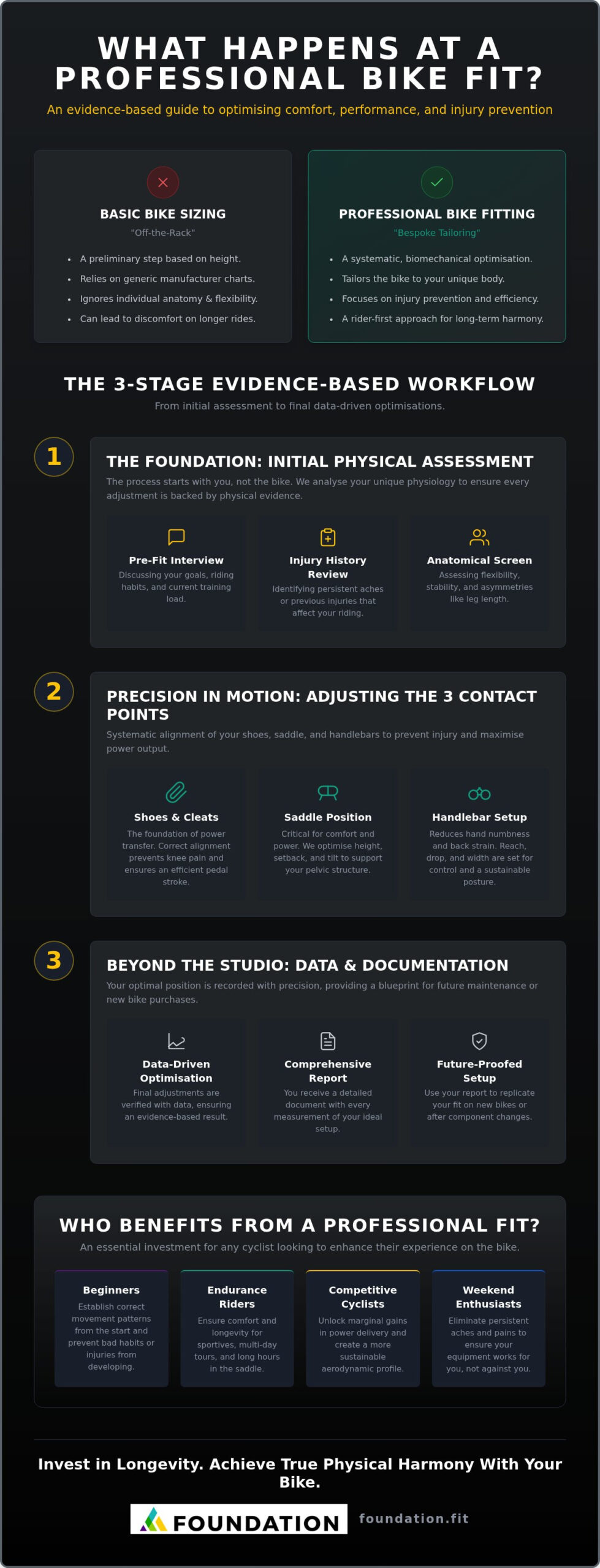
A professional bike fit is often misunderstood as a simple adjustment of seat height or handlebar reach. In reality, it is a systematic optimisation of the human-machine interface through rigorous biomechanical analysis. Whilst many cyclists rely on generic height charts to set up their equipment, these methods ignore the complexities of individual anatomy. Precision requires a shift in perspective where the rider, rather than the bicycle, dictates the final geometry. This evidence-based approach ensures that the bike is tailored to the person, not the other way around.
It’s vital to distinguish between bike sizing and bike fitting. Sizing is the preliminary step of selecting the correct frame dimensions based on your height or inside leg measurement; it’s like buying a suit off the rack. Fitting is the bespoke tailoring that follows. By understanding your bicycle and how its adjustable components interact with your joints, a fitter can balance comfort, power output, and aerodynamic efficiency. When considering what happens at a bike fit, the primary objective is always the prevention of chronic injury. A setup that feels adequate for ten miles can become a source of debilitating knee or back pain after fifty because a generic setup forces the body to compensate for mechanical misalignment.
The Philosophy of Rider-First Geometry
The core philosophy of modern fitting is that the body should never be forced to adapt to the machine. Every individual possesses unique limb lengths, pelvic widths, and levels of spinal flexibility. A clinical approach to ergonomics ensures that the bike supports these natural movements. Instead of pushing through discomfort, we use data to align the pedals, saddle, and bars with your specific range of motion. This meticulous attention to detail is what separates a professional consultation from a basic shop setup. Understanding what happens at a bike fit helps demystify the science behind why a specific saddle setback or cleat rotation is necessary for your unique gait.
Who Should Consider a Professional Fit?
Many believe that professional fitting is reserved for elite athletes. However, beginners benefit immensely from establishing a foundation of correct movement patterns before bad habits or injuries set in. For endurance riders tackling sportives or multi-day tours, a fit is an essential investment in longevity and enjoyment. Competitive cyclists also find value here, as even marginal gains in power delivery or a more sustainable aerodynamic profile can lead to significant performance improvements. Whether you’re a weekend enthusiast or a seasoned racer, a professional fit ensures your equipment works for you, not against you.
The Foundation Begins with You: The Initial Physical Assessment
Many cyclists arrive at a studio expecting to immediately mount the trainer. However, the most vital part of what happens at a bike fit occurs before you even clip into your pedals. A professional fit is a clinical process that treats the bicycle as a secondary component to your own unique physiology. Your body is the engine, and the machine must be configured to support your specific skeletal structure and muscular capabilities. By starting with a comprehensive off-the-bike assessment, we ensure that the final setup is a reflection of your physical reality rather than a generic template.
This stage involves a meticulous review of your cycling history, including any previous injuries or persistent “niggles” that appear during long rides. We look for anatomical asymmetries, such as leg length discrepancies or variations in foot structure, which often dictate how the body compensates under load. Understanding the biomechanics of cycling requires this level of individualised scrutiny. Establishing this baseline is the first step in a Full Bike Fit, ensuring that every subsequent mechanical change is backed by physical evidence.
The Pre-Fit Interview and Goal Setting
The consultation begins with a detailed dialogue about your aspirations and current riding habits. Whether you’re training for a high-intensity road race or planning a relaxed weekend tour, your goals dictate the rationale behind every adjustment. We’ll analyse your current weekly mileage and discuss how your body responds to that training load. This conversation identifies specific areas of discomfort, such as lower back stiffness or saddle sores, allowing the fitter to prioritise interventions that provide the greatest relief. It’s a collaborative process where your feedback is as valuable as the data itself.
Biomechanical and Flexibility Screening
Once the interview is complete, we move into a physical screening to determine your unique range of motion. Testing the flexibility of your hamstrings and gluteal muscles is essential for finding your optimal saddle height and reach. We also assess core stability, as a rider’s ability to maintain a steady torso directly impacts their efficiency and comfort on the handlebars. Functional range of motion in a cycling context refers to the degree of movement a joint can achieve whilst maintaining stability and delivering power under the specific loads of the pedal stroke. By identifying these physical boundaries, we can create a position that feels natural rather than forced. This ensures that when you finally get on the bike, the adjustments are already tailored to what your body can sustainably achieve.
Precision in Motion: Adjusting the Primary Contact Points
Once the initial physical assessment is complete, the focus shifts to the bike itself. A professional fit organises the three primary contact points where your body meets the machine: the feet, the pelvis, and the hands. These interfaces dictate how you transfer power and how your body absorbs the vibration of the road. When considering what happens at a bike fit, this phase is where biomechanical data is translated into mechanical adjustments. We treat these points as a holistic system rather than isolated parts, ensuring that a change at the pedals supports the stability of the pelvis and the comfort of the cockpit.
The Shoe and Cleat Alignment
The foot-pedal interface is the foundation of your power stroke. Precision cleat positioning is essential to prevent lateral knee strain and the burning sensation often described as “hot foot”. We evaluate your natural foot tilt and may use wedges or shims to accommodate varus or valgus alignments, ensuring your lower limbs move in a healthy, efficient plane. This level of detail is a core component of our Shoe & Cleat Fit service, which focuses on aligning the foot to ensure long-term joint health and efficient energy transfer.
Saddle Testing and Pelvic Stability
Your saddle is the bedrock of a stable pedalling platform. We adjust height, fore-aft position, and tilt to ensure your pelvis remains neutral under load. Through Saddle Testing and pressure mapping, we identify the correct width and shape for your specific anatomy. This prevents the pelvic rocking that often leads to lower back pain and helps eliminate common issues like saddle sores. A well-positioned saddle also improves your centre of gravity, making the bike feel more predictable and stable during technical descents or high-speed cornering.
Cockpit Reach and Handlebar Geometry
The final contact point involves cockpit optimisation. We adjust stem length and handlebar rotation to reduce pressure on the ulnar nerve and wrists, preventing the numbness that many riders experience. This process balances an aerodynamic profile with the practical reality of your flexibility and core strength. We also ensure that hood and lever reach are tailored to your hand size for safer braking and gear shifting. By organising the front end this way, we eliminate the neck and shoulder tension that typically develops over long distances. This systematic approach is a defining part of what happens at a bike fit, turning a standard bicycle into a precision tool for your athletic journey.
Beyond the Studio: Data, Documentation, and Adaptation
The final phase of a professional consultation ensures that the physical changes made in the studio are translated into a permanent, repeatable record. Once the biomechanical adjustments are complete, we use digital tools or traditional precision instruments to capture every coordinate of your new position. This documentation is a vital part of what happens at a bike fit, turning a series of manual adjustments into a technical blueprint. It provides you with the peace of mind that your ideal setup is preserved, regardless of whether you need to perform maintenance or transport your bike overseas.
We don’t simply hand over a list of numbers and conclude the session. A professional fit includes a structured follow-up protocol to monitor how your body responds to the new geometry in real-world conditions. Biomechanical changes often require a period of refinement as you move from the controlled environment of the studio to the varied terrain of the road. This transition is a collaborative effort between the rider and the fitter, ensuring that the evidence-based setup delivers the promised results in terms of both comfort and performance.
The Comprehensive Fit Report
The fit report is an essential document that details specific metrics such as “Stack and Reach”, saddle setback, and handlebar rotation. These coordinates allow you to replicate your position on a second bike or a holiday rental with millimetre precision. This data is particularly valuable if you are considering a New Bike Sizing service before investing in a new frame. By comparing your ideal coordinates against the geometry charts of various manufacturers, we can identify which brands and models will best support your unique physiology before you make a purchase. This proactive approach eliminates the risk of buying a frame that is fundamentally unsuitable for your needs.
The Adaptation Phase
It’s important to understand that your body requires an adaptation period to “bed in” a new position. Even if the new setup is objectively superior, your nervous system and muscles have developed patterns based on your previous geometry. We recommend a series of lower-intensity rides initially to allow your body to adjust to the shifted loads. You might experience some “new muscle soreness” as different muscle groups are recruited more effectively, which is a normal part of the process. However, this should be distinguished from “injury pain”, which is sharp or persistent. If you find that a specific adjustment feels restrictive after several rides, you should contact your fitter for a minor refinement. To ensure your setup remains optimised as your fitness evolves, we recommend you book a Full Bike Fit whenever you change your primary equipment or training goals.
Investing in Longevity: Why Precision Fitting is a Cyclist’s Best Asset
A professional bike fit is often viewed through the lens of performance, yet its most significant value lies in the preservation of your physical health. It is not merely an expense; it is a strategic investment in your long-term enjoyment of the sport. By ensuring that every mechanical setting is tailored to your unique physiology, you eliminate the micro-traumas that accumulate over thousands of pedal revolutions. Understanding what happens at a bike fit reveals a process dedicated to creating a sustainable relationship between rider and machine, allowing you to ride further and faster without the looming threat of chronic pain. This psychological confidence, knowing your equipment is perfectly synchronised with your body, is a powerful asset for any athlete.
Precision fitting allows you to maximise every watt of power through superior mechanical and anatomical leverage. When your joints are aligned correctly, your muscles can fire in their most efficient patterns, reducing fatigue and increasing your sustained speed. This meticulous optimisation ensures that no energy is wasted on unnecessary stabilising movements or fighting against a restrictive position. It turns the bicycle into a natural extension of your body, rather than a mechanical obstacle you must overcome.
The Clinical Approach to Injury Prevention
Subtle changes in cleat rotation, saddle setback, or handlebar tilt can be the difference between a healthy knee and a debilitating repetitive strain injury. A specialist fitter brings an expert eye to the studio, spotting subtle movement patterns or compensations that a rider simply cannot feel from the saddle. This clinical oversight is essential for addressing the root causes of lower back stiffness or hip impingement. By prioritising these biomechanical corrections, you ensure that your cycling journey remains uninterrupted by preventable physical issues. The goal is to create a position that supports your skeletal structure under load, protecting your joints for years to come.
The Foundation Advantage
Choosing a studio that focuses exclusively on technical assessments provides a distinct advantage. At a specialist facility, the priority is always the individualised journey rather than a quick retail sale. This data-driven approach removes the guesswork from your setup, providing a clear rationale for every adjustment made. When you reflect on what happens at a bike fit, you’ll recognise it as a transformative education that empowers you to take control of your performance and comfort. If you are ready to transform your ride, book a Full Bike Fit with Foundation and experience the benefits of an expert-led, precision-driven setup.
Transform Your Cycling Experience Through Precision
A professional bike fit is a transformative process that shifts the focus from the machine to the rider. By prioritising your unique biomechanics, you move away from the frustration of generic setups and toward a position that supports your long-term health. We’ve explored how what happens at a bike fit involves a meticulous journey from initial physical assessment to the final cockpit optimisation. This systematic approach ensures that persistent aches, such as knee strain or lower back stiffness, are replaced by mechanical efficiency and physical harmony.
Our studio provides a comprehensive suite of technical services, including a specialist biomechanical assessment and a specialised Saddle Testing programme to resolve seating discomfort. Every session concludes with a detailed technical fit report, giving you the data needed to replicate your ideal coordinates on any future frame. Don’t let preventable discomfort limit your potential on the road or trail. Book your precision Full Bike Fit today and rediscover the joy of riding a bicycle that is perfectly tailored to you. Your body will thank you for every mile that follows.
Frequently Asked Questions
How long does a professional bike fit typically take?
A comprehensive fitting session typically takes between two and three hours to complete. This duration allows for a thorough physical assessment and the methodical adjustment of your contact points without rushing the process. Every session follows a logical structure, beginning with a detailed consultation before moving into dynamic measurements on the bike. This steady pace ensures that every biomechanical rationale is fully explained and every adjustment is validated by data.
Do I need to bring my own bike to the fitting session?
Yes, you should bring the bicycle you intend to ride most frequently. The primary goal of the session is to optimise the interface between your body and your specific machine. If you are currently between bikes or planning a purchase, our New Bike Sizing service uses a dedicated adjustable jig to determine your ideal frame geometry. This ensures you buy the correct size and model before any components are permanently set.
What should I wear for my bike fit appointment?
You should wear your usual cycling kit, including bib shorts and a fitted jersey. This allows the fitter to see your joint movements clearly and ensures the assessment reflects your real-world riding conditions. It’s also vital to bring your cycling shoes, as cleat alignment is a fundamental part of the process. Wearing the correct kit helps in capturing accurate data during the dynamic phases of the assessment.
Can a bike fit help with numbness in my hands or feet?
A professional fit is an effective solution for nerve compression that causes numbness. Hand numbness often results from excessive pressure on the ulnar nerve due to poor cockpit geometry. Foot numbness is frequently addressed through specialised shoe and cleat alignment. When you understand what happens at a bike fit, you’ll see how redistributing your weight and aligning your joints removes the mechanical stress that leads to these frustrating sensations.
Is a bike fit only for professional or competitive cyclists?
No, a precision fit is beneficial for cyclists of all ability levels and disciplines. Beginners benefit immensely from establishing a foundation of correct movement early on, which prevents bad habits from forming. Endurance riders and commuters use the service to eliminate persistent aches and increase general comfort. Whether you’re training for a race or enjoying weekend tours, a fit is an investment in your long-term health and enjoyment.
How often should I have my bike fit reviewed or updated?
We recommend a review every 12 to 18 months or after any significant physical changes. Your flexibility, core strength, and weight can shift over time, which may alter your ideal position. It is also vital to re-assess your setup if you experience new discomfort, increase your training volume significantly, or change primary equipment like your saddle or shoes. Regular reviews ensure your bike continues to support your evolving physiology.
What happens if I buy a new pair of cycling shoes after my fit?
If you purchase new footwear, it’s essential to have your cleats professionally aligned to maintain your established position. Different shoe brands often feature variations in stack height and cleat hole placement that can disrupt your biomechanics. Our Shoe & Cleat Fit service ensures your new equipment is synchronised with your existing fit data. This proactive approach prevents the development of new joint strain that can occur from even minor pedal misalignments.
Will a bike fit make me faster on the road?
A professional fit will likely make you faster by improving your mechanical efficiency and aerodynamic sustainability. When your body isn’t fighting discomfort, you can deliver power to the pedals more effectively. A precise setup allows you to hold an efficient, lower position for longer periods without straining your back or neck. This leads to improved average speeds and reduced fatigue, allowing you to perform better over longer distances.


