

A professional bike fit is often mistaken for a simple mechanical adjustment, but in reality, it’s a technical consultation that harmonises your unique physiology with your machine. One of the first questions many riders ask is, how long does a bike fit take, and the answer reflects the clinical rigour required to ensure your body isn’t fighting the bike. It’s frustrating to invest in a high-performance frame only to have your rides cut short by persistent numbness or lower back pain, whilst many cyclists worry that a lengthy appointment might just be a series of superficial tweaks.
You deserve to understand exactly where your time and effort are going. This guide will demystify the fitting process, explaining why a methodical, biomechanical assessment is essential for both your performance and your long-term health. We’ll provide a clear timeline for a Full Bike Fit, distinguish it from a basic sizing session, and outline the specific technical steps taken to help you ride pain-free. By the end, you’ll have the confidence to invest the necessary time into a process that prevents injury and transforms your cycling experience.
Key Takeaways
- Understand that the answer to how long does a bike fit take is rooted in the 2-3 hours required for a comprehensive biomechanical assessment of your unique physiology.
- Learn why a Full Bike Fit prioritises clinical precision over speed, ensuring the intersection between your body’s adaptability and the bike’s adjustability is perfectly optimised.
- Discover how technical variables, such as integrated cockpits and electronic shifting, can influence the duration and complexity of your appointment.
- Maximise your session by bringing the correct equipment, including clean cycling shoes and your favourite bib shorts, to ensure data accuracy during the fitting.
- Recognise the value of an unhurried, dedicated studio environment where the focus remains entirely on your performance and injury prevention.
The Rationale Behind the Clock: Why Precision Fitting Takes Time
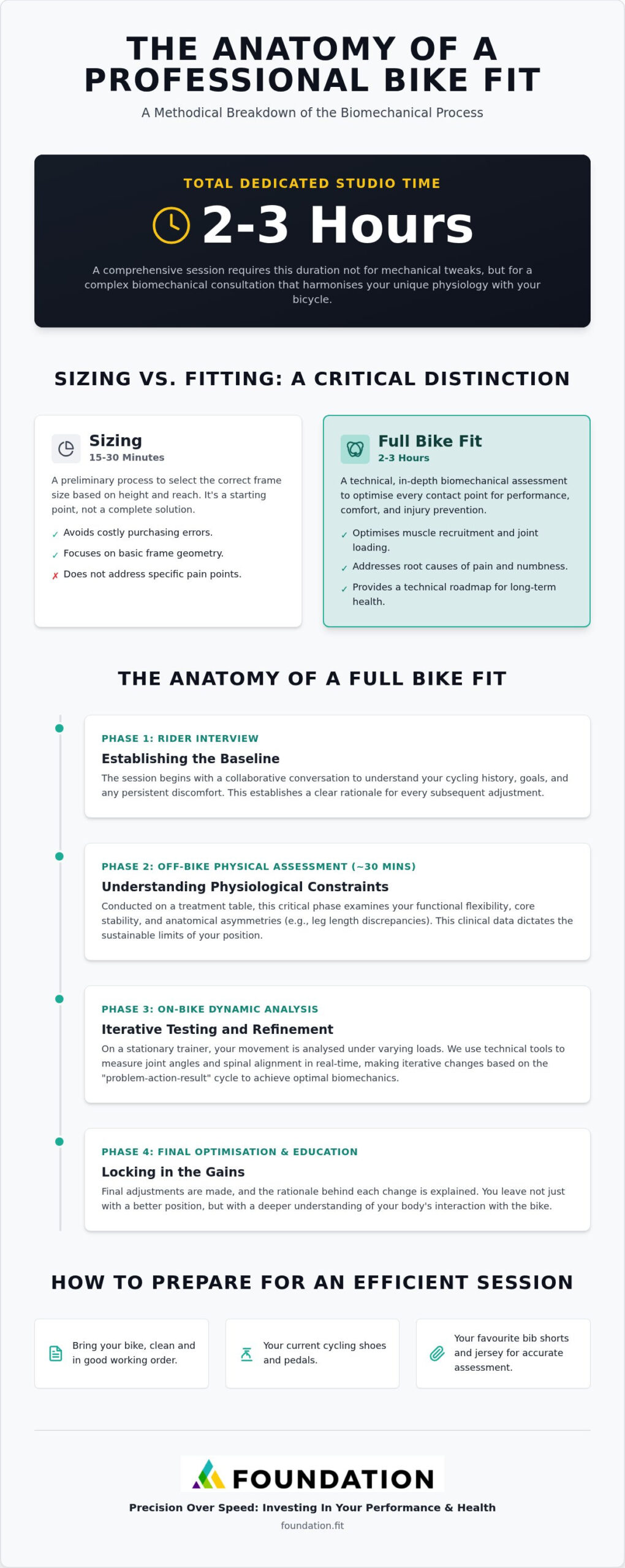
A professional bike fit is a biomechanical consultation, not a mechanical service. When riders ask how long does a bike fit take, they are often surprised to learn that a comprehensive session requires two to three hours of dedicated studio time. This duration isn’t a reflection of the time needed to turn a hex key; it’s a reflection of the complexity of the human body. Your physiology is inherently adaptable, whilst the bicycle is rigidly adjustable. Finding the exact intersection where these two forces harmonise requires a methodical, data-driven approach that cannot be shortcut.
The Difference Between Sizing and Fitting
It is vital to distinguish between a quick shop “sizing” and a technical fit. Sizing is a preliminary process, often taking 15 to 30 minutes, focused on ensuring you select the correct frame size based on height or reach. Our New Bike Sizing service follows this logic, helping riders avoid costly purchasing errors before they commit to a frame. However, a Full Bike Fit is an entirely different discipline. It involves a deep dive into bicycle frame geometry to optimise every contact point. If your goal is injury prevention or sustained performance, a rushed 15-minute adjustment simply cannot account for the subtle biomechanical nuances that cause persistent knee pain or numbness.
Precision fitting relies on the concept of marginal gains. A five-millimetre shift in saddle height can fundamentally alter muscle recruitment patterns and joint loading. These changes require iterative testing. We make an adjustment, observe the result under load, and refine again. This “problem-action-result” cycle is why the process takes time, but it’s also why the results are so transformative for your riding experience.
Why Clinical Rigour Requires Patience
Adopting an “Expert Mentor” philosophy means we don’t just move your handlebars; we explain the rationale behind every decision. This demystification process is essential for your long-term athletic journey. To get an accurate assessment, a fitter must observe you riding under load. Biomechanical behaviour changes when you’re fatigued or pushing higher power, and these patterns only emerge after sustained effort on the pedals. A superficial adjustment made whilst you’re stationary won’t hold up during a four-hour Sunday ride.
A methodical pace ensures no detail of your unique anatomy is overlooked. From foot arch stability to pelvic tilt, every factor is measured with clinical rigour. This unhurried environment in a dedicated studio allows for a level of precision that retail-focused shops often struggle to provide. You aren’t just paying for a session; you’re investing in a technical roadmap for your future comfort and efficiency.
The Anatomy of a Full Bike Fit: A Phase-by-Phase Breakdown
Every professional session begins with a conversation. Before we even touch the bike, we spend time understanding your cycling history, your goals, and any persistent discomfort you’ve experienced. This collaborative interview allows the fitter to act as a Scientific Guide, mapping out a technical strategy tailored to your specific needs. By establishing this baseline, we ensure that every subsequent adjustment is rooted in a clear rationale rather than guesswork. Data collection starts here, forming the foundation of the entire biomechanical journey.
Phase 1: The Off-Bike Physical Assessment
A technical bike fit begins on the treatment table, not the saddle, to understand the rider’s unique physiological constraints. This initial assessment typically takes around 30 minutes and is arguably the most critical phase of the appointment. We examine your functional flexibility, core stability, and any anatomical asymmetries, such as leg length discrepancies or pelvic tilts. If we don’t understand how your body moves off the bike, we cannot possibly optimise how it performs on it. This clinical data dictates the limits of your position, ensuring the final setup is sustainable for your specific anatomy.
Phase 2: On-Bike Dynamic Analysis
Once we move to the stationary trainer, the process becomes iterative. We observe your movement patterns under varying intensities, as your posture often changes when you’re under load. Riders often ask how long does a bike fit take during this dynamic phase, as they watch the data points shift with every millimetre of adjustment. We use technical tools to measure joint angles and spinal alignment in real-time, making a change and then immediately re-testing the movement. This cycle of observation and refinement ensures that we find the most efficient balance between aerodynamics, power output, and comfort.
Phase 3: Specialist Adjustments (Cleats and Saddles)
The final hour is often dedicated to the fine-tuning of your primary contact points. A Shoe & Cleat Fit is essential because even a minor misalignment at the foot can lead to significant knee or hip issues over long distances. We also focus on Saddle Testing, which is rarely a “one and done” process. Finding the correct ergonomic support requires testing different widths and profiles whilst monitoring your pelvic stability. Our Full Bike Fit incorporates these specialist modules to ensure no aspect of your interface with the machine is left to chance. These refinements are what turn a good position into a perfect one, providing the precision needed for long-term injury prevention.
Variables That Influence Your Time in the Studio
While we provide a standard window of two to three hours for a session, the exact answer to how long does a bike fit take depends on several technical variables. Every rider brings a unique set of physical requirements and mechanical challenges to the studio. A specialist environment is designed to accommodate these nuances, but certain factors naturally require a more intensive level of intervention to achieve a precise result. Understanding these variables helps you set realistic expectations for your appointment.
Discipline-Specific Requirements
The type of cycling you do dictates the complexity of the biomechanical assessment. Different disciplines require different postural priorities:
- Road Cycling: This serves as our technical benchmark. The focus is on balancing endurance, comfort, and sustainable power over long distances. Most road sessions fit comfortably within the standard duration.
- TT and Triathlon: These sessions often require an extended duration. The challenge lies in the delicate trade-off between aggressive aerodynamic optimisation and the rider’s physiological capacity to breathe and produce power in a constricted position.
- Off-Road (Gravel and MTB): Fitting for technical terrain introduces different demands. We must account for dynamic handling, weight distribution for steep climbs, and the impact of constant vibration on the rider’s contact points.
Hardware and Component Swaps
The complexity of your bicycle’s hardware significantly impacts the mechanical portion of the fit. Modern integrated cockpits with internal cable routing look sleek, but they make swapping a stem or adjusting handlebar height a time-consuming task. If a component change is necessary to reach your optimal position, the technical work must be done with meticulous care to ensure safety and precision. Similarly, a detailed Shoe & Cleat Fit may involve the use of wedges or shims to correct alignment issues. These adjustments are vital for power transfer but require iterative testing to get exactly right. A specialist studio is equipped to handle these technical changes efficiently, ensuring the focus remains on your progress.
Your personal history also plays a role. A rider with a complex injury history, such as previous spinal surgery or chronic knee issues, requires a more cautious and thorough assessment. We don’t rush these cases; we move slowly to ensure every change is tolerated well by your body. Similarly, if you wish to fit multiple bikes or use several pairs of cycling shoes, we’ll need to allocate additional time to replicate the data across your equipment. A methodical approach ensures that whether you’re on your road bike or your TT rig, the biomechanical rationale remains consistent and effective.
How to Prepare for an Efficient Fitting Session
Preparation is the most effective way to ensure your time in the studio is spent on high-level biomechanical analysis rather than basic mechanical troubleshooting. While the answer to how long does a bike fit take is typically two to three hours, arriving unprepared can extend this window unnecessarily. By taking a few deliberate steps before your appointment, you allow the fitter to focus entirely on your physical harmony with the machine. This proactive approach ensures we maximise every minute of your session.
The most valuable thing you can bring to the studio is a clear record of your physical history. We encourage riders to document any persistent “niggles,” numbness, or sharp pains they experience during or after a ride. Be specific about when these sensations occur. Do they appear after thirty minutes or three hours? Are they triggered by high-intensity efforts or steady-state cruising? Providing this data during the initial interview streamlines the diagnostic phase, allowing us to move more quickly into the technical assessment.
Bike maintenance is equally critical. A seized seatpost or a corroded stem bolt can halt a fitting session in its tracks. If a fitter has to spend twenty minutes applying penetrating oil to a stubborn bolt, that is time lost from your dynamic analysis. Ensure your bicycle is clean and all adjustable components are moving freely before you arrive. This attention to detail reflects the clinical rigour we apply to the fit itself.
The Essential Kit List
Accuracy in a professional fit relies on replicating your real-world riding conditions. This makes your choice of attire non-negotiable. You must bring your favourite bib shorts, as the thickness and density of the chamois pad significantly influence your effective saddle height. Similarly, clean cycling shoes and cleats are vital. Grit or debris in the cleat channels can prevent the sub-millimetre adjustments required for a precise Shoe & Cleat Fit. If you have specific components you are considering, such as a preferred saddle or a different stem length, bring these along to be integrated into the testing process.
Mindset and Post-Fit Expectations
An efficient bike fit is a partnership where the rider’s feedback is as vital as the fitter’s data. You should arrive prepared for a moderate level of physical exertion. To see how your body behaves under load, we will ask you to pedal at various intensities whilst we monitor your postural alignment. It is also important to manage your expectations for the days following the session. Your body will likely require an adaptation period of several rides to adjust to the new geometry. This “weird” feeling is a natural part of the musculoskeletal system reorganising itself around a more efficient position.
Ready to transform your riding experience with a data-driven approach? Book your Full Bike Fit today and ensure your time on the road is defined by performance rather than discomfort.
Beyond the Clock: Why Foundation Bike Fit Values Precision Over Speed
In a world of instant results, some riders may question how long does a bike fit take and whether a three-hour appointment is truly necessary. At Foundation Bike Fit, we believe that speed is often the enemy of precision. A rushed adjustment is merely a temporary fix, whereas a methodical, three-hour consultation is an investment in your long-term athletic health. We position ourselves as a centre of excellence where the focus remains entirely on the data and your unique physiology. By prioritising clinical rigour over a quick turnaround, we ensure that every change is backed by a technical rationale.
Our commitment to an unhurried, steady pace allows us to explore the nuances of your movement that a superficial shop fitting would overlook. We don’t subscribe to one-size-fits-all solutions; instead, we treat every session as an individualised journey. This meticulousness is what leads to marginal gains in power and significant improvements in comfort. The goal is simple: to create a state of physical harmony between you and your machine that remains stable even under the highest levels of fatigue.
The Studio Advantage
The environment in which a fit takes place is just as important as the fitter’s expertise. Our specialist studio at Lee Valley VeloPark is a dedicated biomechanical space designed for high-level assessment. Because we do not offer general bicycle repairs or retail sales, there are no distractions to pull our focus away from your performance. This controlled setting allows us to utilise advanced technical tools with absolute precision. Within our studio, we have access to specialised equipment, including:
- Saddle Pressure Mapping: To identify and resolve issues with weight distribution and soft-tissue discomfort.
- 3D Motion Capture: To analyse joint angles and postural stability in real-time under varying loads.
- Specialist Testing Units: To iterate through adjustments without the constraints of traditional workshop environments.
Your Next Steps to Optimal Performance
Once you have decided to prioritise your comfort and efficiency, the booking process is designed to be as thorough as the fit itself. After choosing your service, you’ll receive a confirmation that outlines exactly how to prepare, ensuring we can maximise our time together from the moment you arrive. Our relationship with the rider doesn’t end when the session concludes. We provide a detailed summary of your data and a clear rationale for every adjustment made, alongside long-term support to ensure your body adapts correctly to the new position.
Organise your professional Full Bike Fit at our specialist studio today. By investing the necessary time now, you are securing a future of pain-free, high-performance cycling.
Invest in Your Long-Term Cycling Harmony
Choosing to prioritise your physical well-being is the most significant upgrade you can make to your athletic journey. We’ve demystified the process to show that the answer to how long does a bike fit take is defined by the clinical rigour required to harmonise your unique physiology with your machine. A standard two to three-hour session isn’t time spent waiting; it’s a methodical investment in observing, measuring, and refining your biomechanical profile to ensure every contact point is optimised.
At our specialist studio at Lee Valley VeloPark, we focus exclusively on rider ergonomics, removing the distractions of retail to prioritise your performance and injury prevention. This data-driven approach ensures that every adjustment is backed by a technical rationale, providing a sustainable foundation for years of pain-free riding. When you’re ready to move beyond superficial tweaks and embrace a truly professional assessment, our expert mentors are here to support you.
Book your technical assessment at Foundation Bike Fit today and take the first step towards total physical harmony on the bike. We look forward to being a supportive partner in your continued progress.
Frequently Asked Questions
How long does a Full Bike Fit take on average?
A Full Bike Fit typically takes between two and three hours to complete with clinical precision. When asking how long does a bike fit take, it’s important to recognise that this time covers a comprehensive off-bike physical assessment and dynamic on-bike analysis. This duration ensures we have enough data to make informed decisions about your saddle height, reach, and cleat alignment without rushing the technical rationale behind every adjustment.
Will I need more than one session to get the perfect fit?
Most riders find that a single, unhurried session provides the definitive technical setup they need for long-term comfort. While the initial appointment covers all primary adjustments, we provide a detailed summary and follow-up rationale to support your progress. The body requires an adaptation period to reorganise around the new geometry, so we encourage riders to complete several rides before requesting further refinements to their position after the initial fit.
Does a New Bike Sizing take as long as a Full Bike Fit?
A New Bike Sizing is a more targeted service that usually takes around one hour to complete. Unlike a Full Bike Fit, which focuses on optimising an existing machine, sizing is a proactive step to ensure you select the correct frame geometry before making a purchase. It involves a technical assessment of your reach and stack requirements, helping you avoid costly errors without the extensive dynamic testing used in a full session.
What happens if we run over the allotted time?
Our studio prioritises precision over speed, so we move at a methodical pace that respects the complexity of your physiology. If a session requires additional time due to complex hardware or a unique injury history, we don’t shortcut the process to meet a rigid clock. The controlled studio environment allows us to focus entirely on your ergonomics, ensuring every adjustment is tested thoroughly under load before the appointment concludes.
Can I get two bikes fitted in the same appointment?
Fitting two bikes in a single appointment is possible, but it significantly extends the total time spent in the studio. Each machine has unique mechanical variables and geometry that must be assessed individually. We recommend allocating extra time or booking separate sessions to ensure that both bikes receive the same level of clinical rigour and data-driven optimisation, particularly if they are for different cycling disciplines like road and time trial.
How long should I wait to judge the results of my bike fit?
You should allow for an adaptation period of roughly two to three weeks, or several consistent rides, before fully judging the results. Your musculoskeletal system needs time to adjust to changes in muscle recruitment and joint loading. It’s normal for a new position to feel different initially, but as your body reorganises, the benefits of improved efficiency and injury prevention will become clear during your longer training sessions.
Do I need to be a professional athlete for a 3-hour session?
Professional-level fitting is designed for cyclists of all ability levels, as comfort and injury prevention are universal requirements. You don’t need to be an elite athlete to benefit from a three-hour session; in fact, recreational riders often see the greatest gains in enjoyment when persistent numbness or back pain is resolved. Every session is an individualised journey tailored to your specific physical needs and personal cycling goals.
Is the duration different for a mountain bike versus a road bike?
The duration of a fit can vary depending on the discipline, as the technical priorities for a mountain bike differ from a road setup. Road fits focus on sustainable power and endurance, whereas off-road assessments must account for dynamic handling and technical terrain demands. While the standard answer to how long does a bike fit take remains two to three hours, complex off-road hardware or aerodynamic TT setups may require more intensive intervention.


